
Hidromod provides Advanced Hydrodynamic modelling for Seawater Cooling at Start Campus Data Campus
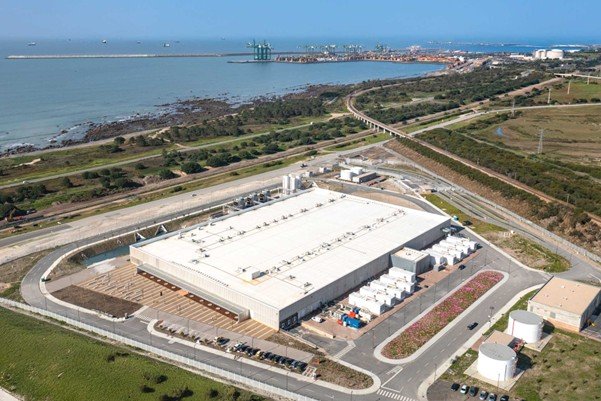
Hidromod, part of ABL, has delivered advanced technical advisory support and specialist hydrodynamic modelling for the seawater cooling system of a data centre developed by Start Campus in Sines, Portugal – one of the first gigawatt-scale facilities globally to use seawater as the main cooling source.
The work, led by the Hidromod team, based in Portugal, combined historical oceanographic data analysis, advanced numerical modelling, and environmental compliance studies to support the design, performance optimisation and long-term operability of the cooling system.
“This project required a high level of technical rigour to accurately characterise the interaction between the cooling system and the surrounding marine environment,”
said José Chambel Leitão, Managing Director at Hidromod.
“By combining long-term oceanographic data with advanced 3D modelling, we were able to demonstrate that the system can operate efficiently while remaining within environmental limits under a wide range of conditions.”
About the Start Campus Data Campus
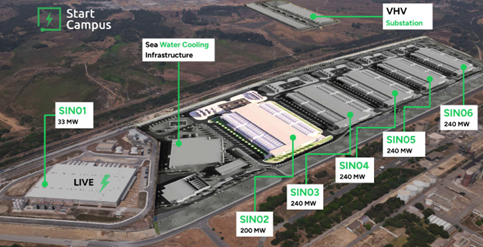
The Start Campus data centre uses a seawater cooling system as a core element of its sustainability and resource-efficiency strategy.
By harnessing the cooling power of the Atlantic Ocean, the development aims to achieve a Water Usage Effectiveness (WUE) of zero, meaning no freshwater consumption for cooling, alongside an optimised design Power Usage Effectiveness (PUE) of approximately 1.1.
The project has been publicly positioned as the world’s first gigawatt-scale data centre cooled using a seawater cooling system. This makes the reliable operation and environmental compatibility of the cooling process a critical component of the overall data centre concept.
Given the scale and sustainability ambitions of the project, ensuring stable and environmentally compliant cooling performance was a critical design requirement.
Rob Dunn, CEO, Start Campus:
“Seawater cooling is fundamental to our strategy to deliver sustainable, large-scale digital infrastructure in Sines and beyond. As we scale towards gigawatt capacity, it is essential that innovation goes hand in hand with environmental responsibility – ensuring we can support the growth of AI and digital economies without compromising natural resources.”
Fábio Coelho, Senior Mechanical Engineer, Start Campus:
“Ensuring that this approach is both operationally robust and environmentally compliant is critical. Through advanced modelling and detailed analysis, the work carried out by Hidromod provides strong technical validation of the system’s performance, giving us confidence that it can operate reliably and within environmental thresholds under a wide range of real-world conditions.”
Hidromod’s scope of work
Rather than a single study, Hidromod’s work represents a multi-year, iterative modelling programme initiated in 2022, combining extensive historical oceanographic datasets with successive simulation phases to continuously refine and validate the performance and environmental compliance of the seawater cooling system.
Hidromod assessed the historical seawater temperature at the site, using satellite data and numerical modelling alongside the definition of representative metocean scenarios to characterise operational conditions. Potential future port development scenarios were also incorporated, based on construction timelines supplied by the Port Authority (APS), to evaluate potential interference with cooling system efficiency.
A three-dimensional hydrodynamic modelling framework was developed and implemented to simulate the thermal plume generated by the cooling-water discharge under relevant metocean and boundary-condition scenarios.
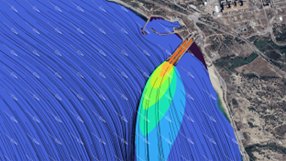
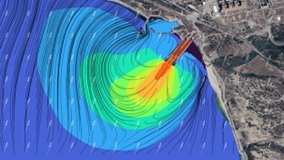
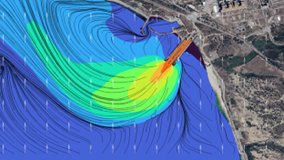
These simulations supported the analysis of water temperature at the intake basin, including the effects of cold-water discharge from a nearby LNG terminal, assessing compliance with requirements for the Environmental Impact Assessment (“EIA”).
The modelling results confirm that the seawater cooling system operates within environmental regulatory thresholds across a range of representative conditions, supporting full compliance with EIA requirements.
As data centre infrastructure continues to scale in both capacity and sustainability ambition, this work demonstrates the critical role of advanced environmental modelling in enabling responsible, large-scale deployment of innovative cooling solutions.
It also reinforces the value of specialist partners such as Hidromod in supporting the next generation of sustainable digital infrastructure, where environmental performance and operational reliability must be closely aligned.