
Understanding Propulsion Shafting Alignment: Design and Survey
Propulsion shafting alignment plays a vital role in ensuring the operational integrity and longevity of marine vessels. As ship designs evolve and engine capacities increase, the challenges associated with maintaining precise shaft alignment have become more pronounced. This blog outlines the key risks, engineering principles, and best practices for managing shaft alignment throughout a vessel’s lifecycle.

The insights presented here are informed by the expertise of André Vidal, Marine Consultant and Head of ABL’s Portugal office. With a background as a fleet manager and class surveyor, particularly across the Mediterranean region, Andre has led a wide range of surveys including hull and machinery damage assessments, condition and pre-purchase surveys, and statutory inspections. His deep technical knowledge of vessel systems and propulsion design underpins the guidance shared in this article.
Watch the full technical presentation here for in-depth technical insights and visual explanations.
This blog covers:
- Key factors influencing propulsion shaft alignment, including thermal rise, hull deflections, and dynamic sea conditions.
- Consequences of misalignment, ranging from bearing damage to high-cost repair interventions.
- Calculation methodologies and installation techniques that support accurate shaft alignment.
- Survey and monitoring practices for maintaining alignment during vessel operation.
- Insights from real-world case studies to promote safer and more reliable ship operations.
Why shafting alignment is a growing concern
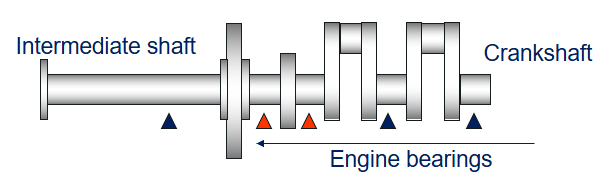
Engine bearing damage is one of the most common consequences of shaft misalignment. A vessel that appears aligned while docked may experience significant shifts once afloat due to hull deflections and thermal expansion. These changes can lead to uneven bearing loads, increased wear, and ultimately mechanical failure if not properly addressed.
Key factors influencing shafting alignment
- Thermal rise: Engine components expand as temperatures increase during operation, altering alignment from the cold baseline condition.
- Hull deflections: Variations in loading—whether in ballast or fully laden—cause the hull to deform, impacting shaft geometry and bearing loads.
- Dynamic sea conditions: Continuous motion at sea introduces bending and torsional forces that further complicate alignment stability.
Design and Calculation Challenges
To achieve uniform bearing load distribution, slope alignment and slope boring techniques are employed. These methods counteract the bending moment induced by the overhung propeller. However, accurate alignment requires consideration of several complex factors:
- Engine Room Deflections: These can be modelled using finite element analysis or measured directly on sister vessels.
- Bearing Load Calculations: Engines with multiple cylinders—such as container carriers with up to 14 units—necessitate detailed crankshaft modelling to simulate realistic load conditions.
Installation Guidance and Industry Trends
Modern installation practices now incorporate pre-sagging alignment, where intentional offsets are introduced to accommodate expected deflections. This approach is particularly important for larger engines, where the magnitude of sagging is greater. Proper implementation helps reduce edge loading on the stern tube bearing and minimises long-term wear.
Practical Guidance for Shafting Alignment Monitoring
Maintaining alignment requires regular inspection and measurement, both in dry-dock and during operation. Key practices include:
- Lignum Vitae Bearings
Clearance measurements should be taken at every dry-dock and verified against classification society standards (e.g., NK Rules).
- White Metal Bearings
Tailshaft wear must be monitored at each dry-dock. A wear increase exceeding 0.3 mm over a 3-year cycle indicates accelerated degradation and warrants further investigation.
- Shaft Flange Coaxiality Checks
Removing bolts between the intermediate and propeller shafts allows for measurement of flange gaps and coaxiality, helping detect misalignment.
- Crankshaft Deflection Monitoring
While afloat, crankshaft deflections can be measured during inspections. If values exceed manufacturer limits, corrective action such as bearing replacement or realignment may be required.
Why Precision Matters
Accurate shafting alignment is essential to prevent bearing damage, reduce maintenance costs, and ensure optimal engine performance. It is influenced by:
- Static factors such as propeller weight and hull structure
- Dynamic factors including sea conditions and thermal expansion
- Operational factors like loading condition and engine room configuration
ABL’s technical specialists apply advanced modelling techniques and field-proven methodologies to deliver bespoke shafting alignment solutions. Our services support shipowners and operators in achieving long-term reliability and performance.
Contact us today to discuss how we can assist with alignment assessments, installation support, and preventative maintenance strategies.